

Stormwater Management
Regulations keep tightening. Timelines keep shrinking. You need a partner who gets it and has for over 50 years. Jensen delivers engineered stormwater solutions from a family that's been building infrastructure since 1968.
Solutions:
Choose Your Solution
Three categories. One partner. Every project covered.

Detention
Manage Stormwater Storage
Underground vault and chamber systems for detention, retention, and infiltration. Manage peak runoff, meet storage mandates, and maximize buildable land.

Treatment
Improve Water Quality
Separators, filters, and biofiltration to meet water quality permit requirements. NJDEP certified, TAPE approved, CA Water Board compliant.

Conveyance
Move Water Efficiently
Reinforced concrete pipe, box culvert, and drainage structures manufactured at Jensen plants across the West for fast, local delivery.
The Challenge
Every project is different, but the headaches are the same. Changing regulations, tight approval windows, and long lead times from manufacturers who don't understand your local market. You shouldn't have to chase drawings or explain your specs twice.
- Regulations shift faster than designs can keep up
- Generic solutions that don't fit your site constraints
- Weeks waiting for drawings and submittals
Why Engineers & Contractors Choose Jensen

Drawings in Days, Not Weeks
Our in-house engineering team turns around project-specific drawings and submittals faster than anyone in the West.

We're Where You Work
Arizona to SoCal to the Pacific Northwest. We know your regulations, municipalities, climate, and deadlines.

Family Owned Since 1968
Three generations of infrastructure builders. Your project is personal to us, not just a ticket number.
Stormwater Expertise
Real projects. Real results.
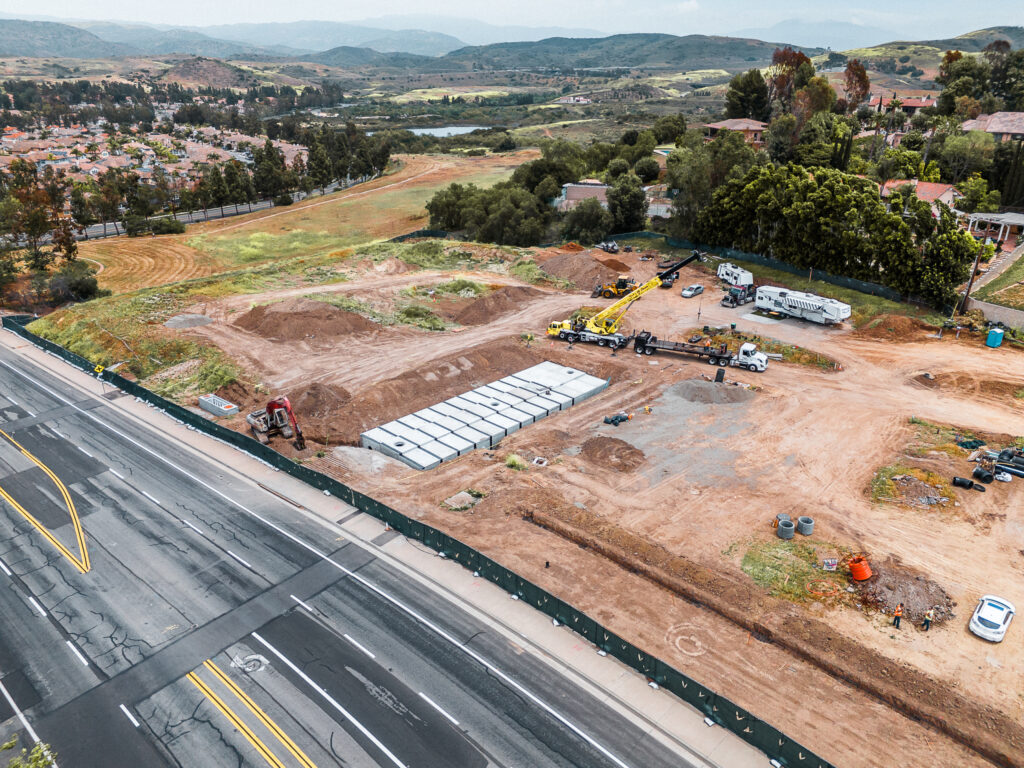
Santa Ana Development Selects StormVault Detention System
In sunny Southern California, land is as precious as it is finite. So, when the Cowan Ranch Estates, a new luxury residential project in Santa Ana, California, was being planned, developers knew they wanted to maximize buildable area.
Frequently Asked Questions
How do you manage stormwater runoff?
Stormwater runoff is managed by controlling where water goes, how fast it moves, how much is stored, and how clean it is before release or reuse. A complete stormwater strategy typically combines conveyance systems, detention or retention storage, infiltration, treatment, and controlled discharge to reduce flooding, erosion, and downstream impacts. EPA and ASCE both emphasize that effective systems often use a mix of gray infrastructure, green infrastructure, and natural processes to reduce runoff volume and improve water quality.
In practice, that may mean capturing runoff in underground storage, vaults, basins, permeable systems, or treatment structures; slowing peak flows; allowing water to infiltrate where soils permit; removing pollutants; and, where feasible, reusing stormwater for beneficial purposes. The best approach depends on site constraints, rainfall patterns, soil conditions, regulatory requirements, and downstream capacity, but the goal is always the same: turn stormwater from a liability into a managed resource.
What are the main types of stormwater management systems?
The main types of stormwater management systems are designed to convey, control, treat, store, infiltrate, or reuse runoff. While conveyance and storage infrastructure manage the movement and volume of stormwater, engineered treatment systems are increasingly used to improve water quality and meet regulatory requirements. These solutions include hydrodynamic separators, media filters, biofilters, screening systems, and other proprietary technologies that target sediment, trash, nutrients, hydrocarbons, metals, and other pollutants before they reach receiving waters.
Common stormwater management solutions include underground detention and retention systems, treatment vaults, infiltration systems, stormwater harvesting and reuse systems, and pump stations that help move or discharge water where gravity flow is not feasible. The most effective designs combine multiple technologies to address site-specific challenges, balancing flow control, water quality treatment, and system performance to reduce flooding, protect waterways, and support long-term watershed health.
What is a treatment train and why does it matter?
A treatment train is a stormwater management approach that uses multiple practices or technologies in sequence, with each component targeting different pollutants or runoff characteristics. Rather than relying on a single device to do all the work, a treatment train combines complementary systems, such as screening, hydrodynamic separation, filtration, biofiltration, detention, or infiltration, to achieve higher levels of treatment and overall system performance.
Treatment trains matter because stormwater contains a complex mix of pollutants, including trash, sediment, nutrients, hydrocarbons, metals, and bacteria. No single technology is equally effective at removing every contaminant or managing every flow condition. By pairing systems together, engineers can optimize pollutant removal, improve maintenance efficiency, extend the life of downstream treatment devices, and help projects meet increasingly stringent regulatory requirements. The result is a more resilient and effective stormwater solution that protects both infrastructure and receiving waters.
How quickly can Jensen deliver drawings and submittals?
Jensen understands that project schedules are often driven by submittal approvals and procurement timelines. Our engineering and project teams work closely with customers to provide drawings, calculations, and submittal packages as quickly as possible, helping keep projects moving from design through construction. Lead times vary based on project complexity, product type, and project-specific requirements, but many standard systems can be processed significantly faster than fully custom solutions.
For the most accurate schedule, customers should contact their local Jensen representative early in the design process. By coordinating project requirements, design criteria, and regulatory needs upfront, Jensen can streamline reviews, reduce revisions, and deliver complete submittal packages efficiently to support project deadlines.
Explore Other Solutions
Stormwater is only part of our solutions portfolio. Jensen builds infrastructure solutions across multiple verticals.

Power & Energy Utilities
Utility vaults, transformer pads, handholes, and light pole bases – pre-approved by PG&E, SCE, LADWP, and more.

Data Centers
Precast foundations, vaults, and utility structures for data center power distribution and cooling infrastructure.

Water & Wastewater
Sewer manholes, pump stations, septic systems, and interceptors for utility facility water and wastewater management.